
How to Use AI on Mac: From AI Coding to Android Apps
AI is changing the way people use a Mac. What started with AI-assisted coding has expanded into a much broader ecosystem of AI-powered applications for writing, research, creativity, communication, and entertainment. For developers, AI coding on Mac can simplify tasks such as generating code, explaining errors, and improving existing projects. At the same time, many AI-powered social, companion, and productivity apps are emerging as mobile-first experiences, with some available primarily on Android.
This article explores how Mac users can take advantage of AI across these different scenarios, and how Android apps can be accessed on Mac with the help of an Android emulator.
What Makes Mac Suitable for AI and Coding?
Apple Silicon for AI-Assisted Workflows
Apple Silicon combines CPU, GPU, unified memory, and the Neural Engine to support demanding applications while maintaining power efficiency. Apple also provides frameworks such as Core ML for developers who want to run compatible machine learning models on Apple devices.
Not every AI model needs to run locally. Many popular services use cloud-based processing, while smaller models and selected features can run directly on the Mac. In practice, AI tools on Mac can assist with writing, summarizing, image processing, research, and software development.
A Practical Desktop for AI Coding
A Mac provides a stable environment for common development tools, including Xcode, Visual Studio Code, Terminal, Git, and browser-based AI assistants. Developers can use AI tools to generate code, explain unfamiliar files, suggest fixes, or create documentation.
These tools can reduce repetitive work, but they do not replace testing and review. Developers still need to check generated code, dependencies, security issues, and compatibility with the rest of the project.
Multitasking for AI Development
AI coding rarely happens in isolation. Developers may switch between an IDE, Terminal, documentation, testing tools, and an AI assistant during the same session.
Mac’s window management and support for external displays make this workflow easier to handle, while also leaving room for communication and entertainment after work.
From AI Coding to AI-Powered Experiences
AI Beyond Coding
AI is no longer limited to software development. AI-powered apps now support conversations, virtual companionship, language learning, content creation, image editing, and other interactive experiences.
For example, users can interact with AI companions, practice languages with AI-powered feedback, or use AI tools to create and edit visual content. These use cases extend AI beyond traditional productivity and coding workflows.
A Larger Screen for AI-Powered Apps
Using AI-powered apps on a larger Mac display can be useful for longer conversations, content editing, research, and other tasks that involve frequent interaction. A physical keyboard and mouse can also make it easier to enter prompts, navigate interfaces, and manage multiple tasks.
However, not every service offers a native macOS app. When a mobile-first app is unavailable on Mac, an Android emulator can provide another way to access compatible Android apps on a desktop.
Exploring Android Apps on Mac: AI, Social, and More
Android is also home to many AI-focused apps beyond coding tools. Character.AI and Replika, for example, focus on AI conversations and virtual interactions. Language-learning apps such as ELSA Speak use AI-powered feedback to support speaking practice.
Other mobile apps apply AI to image enhancement, video editing, captions, and creative content. Examples include Remini, CapCut, and Picsart. These apps can be useful on a larger screen, especially when users need to review media, enter longer prompts, or manage several tasks at once.
The experience may not be identical to using the app on a phone. Features such as camera access, microphone support, notifications, subscriptions, login methods, and regional availability can vary between the mobile app and an Android emulator.
Bringing Android Apps to Mac with MuMuPlayer
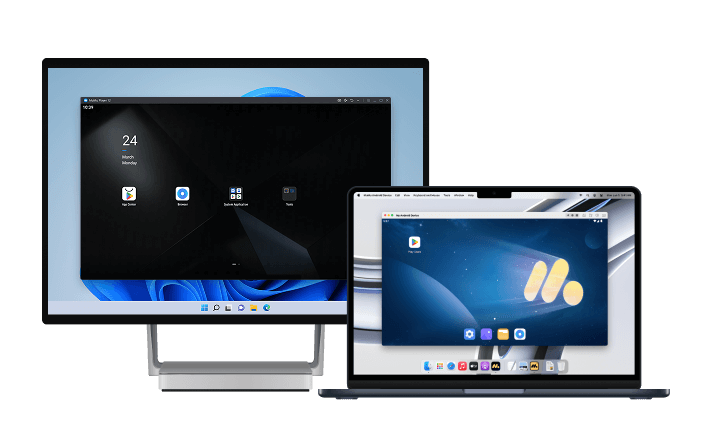
When an Android app does not provide a suitable macOS version, MuMuPlayer for Mac offers a way to run compatible Android games and applications on Mac. Designed specifically for macOS and exclusively for Apple Silicon Macs, MuMuPlayer provides optimized compatibility and a desktop experience tailored to Mac users.
MuMuPlayer is built to deliver best-in-class compatibility for mainstream Android games and apps on Mac, with dedicated macOS adaptation for smoother performance and more reliable operation. Its official features include keyboard and mouse controls, multi-instance support, high-definition graphics, and performance optimization.
To use an Android app on Mac, users can:
- Download MuMuPlayer on your Mac.
- Start an Android device inside the emulator.
- Install a compatible app through Google Play.
- Adjust the display, performance, keyboard, or mouse settings as needed.
MuMuPlayer is a practical choice for users who want to run Android games, social apps, AI conversation tools, and other mobile-first services on a larger Mac screen. Compatibility may vary by app, so users should confirm the requirements for their Mac and the specific application before installation.
FAQs About Using AI and Apps on Mac
Can I Use Mac for AI-Assisted Coding?
Yes. Developers can use Xcode’s coding intelligence, third-party IDE extensions, terminal tools, and web-based AI assistants to generate code, explain errors, refactor files, and create documentation. AI-generated code should always be reviewed and tested before it is used in production.
Can I Run Android Apps on Mac?
Yes. You can run compatible Android apps on Mac using MuMuPlayer, an Android emulator designed for macOS. After installing MuMuPlayer, you can set up an Android environment and install compatible apps through Google Play. App compatibility may vary depending on the app, macOS version, and Mac hardware.
Can I Use Social Apps on Mac?
Usually, yes. Depending on the service, users may use a web version, an official Mac app, or a compatible Android emulator. Some mobile features, including notifications, camera tools, and login methods, may not work exactly as they do on a phone.
Final Thought
Mac now supports a broader range of AI-powered workflows, from AI-assisted coding and productivity to creative, social, and other mobile-first experiences. As more AI-powered services emerge on mobile platforms, compatible Android apps can also expand what users can access on a Mac.
For users who want to explore Android apps on a larger screen, MuMuPlayer for Mac provides a practical way to run compatible Android applications in a desktop environment. Check your Mac and app compatibility, then download MuMuPlayer to explore more ways to use Android apps on Mac.
End of Article